The Female Category
A look at why the scrutiny of transgender women impacts all women.

It is only when we reach the point where we finally start treating women’s sports as an equally legitimate athletic endeavour as men’s sports, that we can fully unravel the perverted focus we have on female athletes as sexual entities first and athletes second. Within this expectation of female athletes lies the deep rooted, Eurocentric standard that has barred so many female athletes who have failed to meet it.
This week, the IOC (International Olympic Committee) announced a blanket ban on all transgender female athletes from competing in the female category at the Olympics, effective from the 2028 LA Olympics. This policy is led by new IOC president Kirsty Coventry, via a working group entitled “Working Group for the Protection of the Female Category” after reviewing “the scientific evidence”. In reading their policy, there is no reference to any specific study or research body that provides this so-called evidence. The policy fixates on the differences in athletic performance between cis male and cis female athletes, which entirely erases the data to show that transgender female athletes on HRT (Hormone Replacement Therapy) perform comparably to cis female athletes. The policy is even bold enough to claim “there is no current evidence that testosterone suppression or gender-affirming hormone treatment eliminates this advantage.”
However, according to this review (based on 52 studies and 6485 participants), trans women on 1-3 years of HRT overwhelmingly compare similarly to cis women. The review states that there are “No significant differences in” upper body strength, lower body strength (jump height) and VO2 max between trans women and cis women. Equally, trans women exhibited lower upper body strength, lower body strength (jump height) and lower VO2 max than cisgender men.
The review concludes: “While transgender women exhibited higher lean mass than cisgender women, their physical fitness was comparable. Current evidence is mostly low certainty and has heterogeneous quality but does not support theories of inherent athletic advantages for transgender women over cisgender women.” The data on cis male athletic performance is therefore not representative of trans female athletic performance and should be considered irrelevant when trying to substantiate policies on the inclusion of transgender women in women’s sports.
The way in which the IOC intends to regulate its exclusion of transgender women is via an “SRY Gene Screening” which is described as a one time saliva, cheek swab or blood sample. “SRY Gene screening is almost always sufficient to determine sex for eligibility purposes” reads the policy.
According to Professor Andrew Sinclair, the scientist who discovered the SRY gene in 1990, this screening is “overly simplistic” and “should not be used in that manner”. The IOC policy states “All Biological Female athletes screened will be negative and eligible, and virtually all athletes who screen positive will have testes/testicles that naturally produce testosterone at adult Male levels.” Professor Sinclair rebuts that "[The screening] does not tell you how SRY is functioning, whether a testis has formed, whether testosterone is produced and, if so, whether it can be used by the body”. "The SRY gene alone should not determine who can compete in women's sport."
Additionally, SRY Gene Testing in some countries is illegal, (due to bioethics and human rights laws) and therefore inaccessible, such as in France or Norway. This creates more barriers to entry for female athletes, especially those who may not have the resources or funding to find alternative solutions outside of the country they are from.
This screening opens the door to widespread scrutiny of all women’s bodies and ultimately has little to do with transgender athletes, seeing as there has only ever been one transgender female Olympian. This is the broader issue: “Because a positive SRY Gene screen does not establish a specific DSD [Differences of Sexual Development] diagnosis, further evaluation should be made available to the athlete to determine whether they have CAIS or another rare XY DSD that precludes testosterone’s anabolic and/or performance enhancing effects.”
What does this “further evaluation” look like? How many female athletes are we going to see fail this screening due to a variant gene or DSD? And how many of them are going to be pounced upon by the media when this happens? International human rights’ lawyers say that this policy “violates fundamental and universal human rights … including the right to equality, non-discrimination, dignity, privacy, and bodily autonomy”.
The current gross scrutiny of trans women in sports is not unprecedented, and is in many ways extremely similar to the long history of the exclusion of African women, and other women of colour, from women’s sports. So pervasive is the idea that African female athletes may be prone to higher levels of testosterone, I hadn’t stopped to consider where this idea had originated. Read this excerpt from The Conversation:
“There have been claims that high testosterone occurrence mostly affects women from Africa and South Asia. There is, however, not enough scientific data at present to justify these claims. The appearance of women with high testosterone coming from these areas is likely due to more women from these regions being identified for sex testing by athletics officials. …What this has led to, is the appearance of World Athletics ‘targeting’ African women, based on their supposed masculine features, once they start excelling on the global stage. It seems especially true if they are from developing countries or marginalised backgrounds.”
A very famous recent example of this is the Algerian boxer Imane Khelif’s exclusion from World Boxing events (until she undergoes their “Sex-Testing Policy”) following the right-wing uproar surrounding her gold medal at the 2024 Paris Olympics. One of the unfortunate lines of defence that came out in support of Khelif was that she is “a real woman” and is therefore undeserving of the scrutiny she experienced. But this example only highlights further that the investigation of women’s… womanness, is seemingly only applied to women who don’t fit the standard ideal of femininity. Because it’s seemingly more, or as important for a female athlete to conform to our preconception of femininity as well as be successful. How dare a woman be successful and not conform to these standards? Because it is only after these athletes succeed that they are investigated, not before.
Like all of these trans athletes you’ve never heard of because… they’re not winning. Like Paralympian Valentina Petrillo, who won 11 national titles in the men’s category, but has only achieved two bronze medals in the women’s category. Or Laurel Hubbard (the only trans female Olympian in history), who failed to record a single lift and finished last in her division at the Tokyo Games. Or Megan Youngren, who finished 230th in her bid to qualify for the Trials Marathon USA Olympic Team. Or discus thrower Ingrid van Kranen who finished ninth at the Paralympics, “and no one even noticed her participation — because conservatives here and abroad hadn’t yet chosen trans athletes as a political target.”
In all of the research I have done for this piece I have only found one example of a white cis woman being accused of being a man. The accusation was only made as a salacious, baseless rumour, intended purely to insult its recipient, Helen Stephens. Because what could be worse for a woman than to be seen as masculine! EDIT: I have come across this story of the Swedish women’s soccer team, who were forced to display their genitalia to a physiotherapist on behalf of a doctor. These “gender tests” came during the 2011 Women’s World Cup, after allegations were made against Equatorial Guinea’s team that some of their players were actually male. The allegations were made by the Nigerian team’s head coach, who was known for her conservative views, such as branding homosexuality as “dirty”. This highlights specifically why scrutiny imposed on women of colour, or trans women, subsequently affects all women, in a very direct way.
Intersex athletes have also suffered the indignity of arbitrary scrutiny. Again, seemingly only female presenting intersex athletes have been subjected to gender testing or required to meet some burden of proof that they should be eligible to compete in women’s categories.
What strikes me too, is that apart from the scandals of illegal doping in sports, genetic variations in levels of testosterone are not discussed within men’s sports as a perceived means of athletic advantage. Take for example, this study on Seasonal Variation of Testosterone Levels. Or the fluctuations in T that occur even within one day “One study found young men (30–40 years old) to have average 08.00 testosterone levels (both free and total) that were 30–35% higher than levels measured in the mid- to late afternoon.”
Ultimately it should be accepted that variation in testosterone is not the real issue people have with fairness in athletics. It’s that they don’t like seeing someone who doesn’t fit their preconceived expectation of what a woman is, succeeding. Especially at the cost of someone who does. Why are some women tested and others aren’t? This is the real issue around fairness in women’s sports.
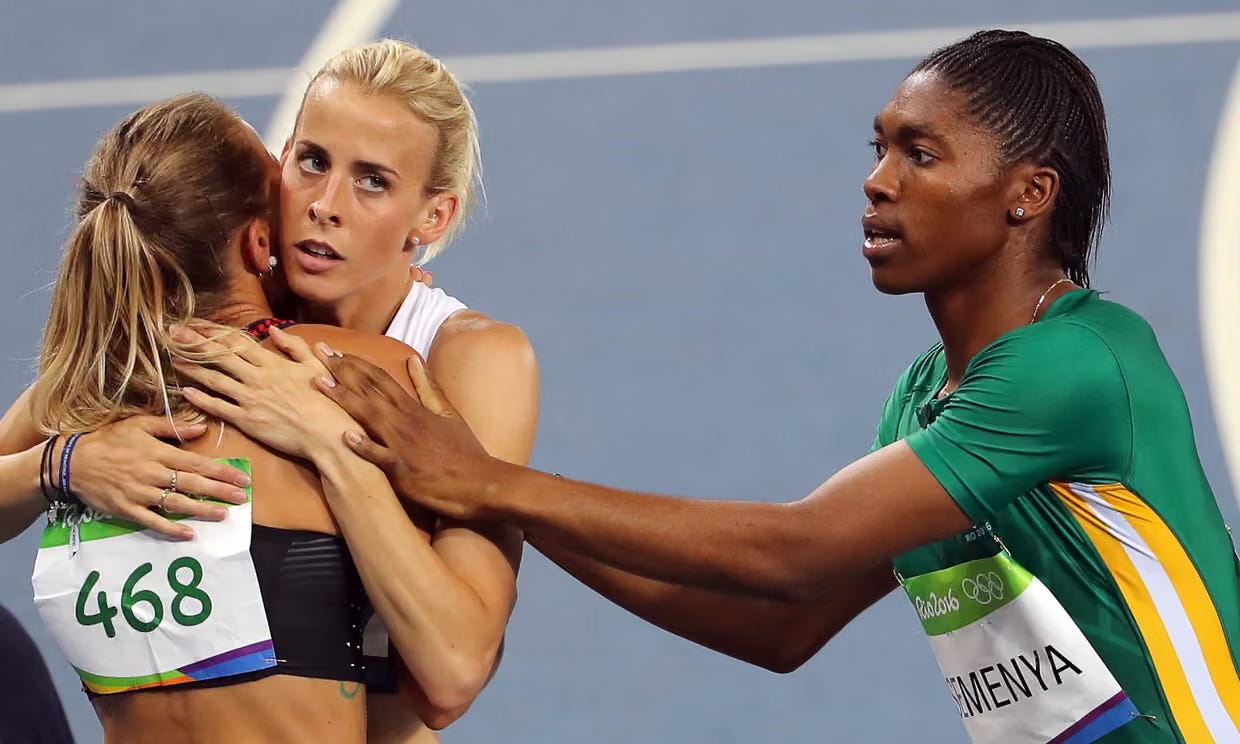
Take for example this photo of runner Caster Semenya, after she has just won gold at the 800m event at the 2016 Rio Olympics. Melissa Bishop, who finished fourth, and Lynsey Sharp, who finished sixth, embrace while denying Semenya recognition of her victory. For years preceding, Semenya had faced intense scrutiny, both from the International Association of Athletics Federations (IAAF), and the media. The IAAF claimed that Semenya benefitted from an “unfair” advantage due to a condition called 5α-Reductase 2 deficiency (catchy, I know), ordering her to take medication in order to reduce her testosterone levels, to meet the eligibility requirements under their guidelines. She did, and still won. “Observers have attributed her athleticism to a single molecule—testosterone—as though it alone earned her the gold, undermining at once her skill, preparation, and achievement.” (The Powers of Testosterone: Obscuring Race and Regional Bias in the Regulation of Women Athletes)
So why was Semenya tested in the first place? “In the case of this athlete, following her breakthrough in the African junior championships, the gossip was starting to build up,” said IAAF spokesman Nick Davies. When women - who do not fit our preconceptions or biases of what a female athlete should look like - succeed in their sports, that is when we take issue. Until women’s sport is treated as legitimately as men’s sport, we lack the structure in which to dismantle our biases towards female athletes.
My waking nightmare is that one day I might potentially succeed in my sport on some level and thus forevermore be barred from a sport I love so much, and subsequently tried by the media in the public eye. If you think I’m being dramatic, just read Austin Killips’ (the cyclist who Trump used as the first political pawn in his current war on trans women in sports) piece here.
Outlining the tactics Trump has used to single out trans women as a distraction from his endless political and ethical transgressions, she points out something conveniently overlooked: “The president talks about trans athletes ‘invading’ women’s sports, while doing nothing at all to elevate, fund or support women athletes.” Like the recent quip he made to the USA men’s Olympic hockey team that he’d begrudgingly have to invite the women’s team to the White House as well as the men’s team. Trump has never cared about women’s sports. This article sums it up perfectly: “[Female athletes] are little more than useful pawns for a political project aimed not at advancing women’s sport but purging transgender people from public life.”
To make things even more arbitrary, the event that Killips won - that Trump took issue with - is an ultra distance bicycle race that isn’t separated into men’s or women’s events. “He’s right: I did snag the record from Alex Schultz (a man) who had previously bested the record held by Lael Wilcox (a woman). A few months after my effort, all of our paces were shattered by a Lithuanian [male cyclist Justinas Leveika] ultra-distance phenom.”
Amidst deafening baseless speculation, and widespread ignorance of scientific research into the athletic performances of transgender women, the goal must then be to uplift women’s sport as a whole, which can only be done by including and treating all women fairly and equally as participants. Transgender women must not be treated as a separate, homogenous entity, but recognised as varying individuals, as all athletes are. Given that we represent such a tiny percentage of all people, let alone athletes, (out of more than 500,000 US College athletes, 10 are transgender) our individual humanity has been lost to our mythologisation.
Many factors play into an athlete’s strengths or weaknesses, depending also on the sport they are competing in. It has been shown for example, that women regularly outperform men in ultra-endurance sports. Things like genetics or hormones contribute to performance, but so do wealth, opportunity and access. (This is a really interesting study on barriers to access to sport for trans people.)
Often these physical differences are celebrated, like Michael Phelp’s unusually wide wingspan (the article literally calls it an “advantage”) or Usain Bolt’s much higher than average number of fast twitch muscle fibers. These genetic differences are not the sole reasons for their success. The combination of many factors, all of which could be referred to as advantages or disadvantages, is.
Our own biological differences are yet to be fully understood. The blundering mistake often made by those who oppose trans women’s participation in women’s sports, is that they believe trans female athletes are merely men who have spontaneously decided to identify as a woman, still entirely with the biology of a cis male. I have been taking HRT, including testosterone blockers, for four years now. I too am eager to understand my own biology - which is why I am seeking out and participating in trans health and performance research projects. Then, we can let the science speak for itself.
- P.S - I’ve won cycling races before, the prize is a sponsored muesli bar. I can buy a muesli bar for less than the cost of hormones, just saying.